
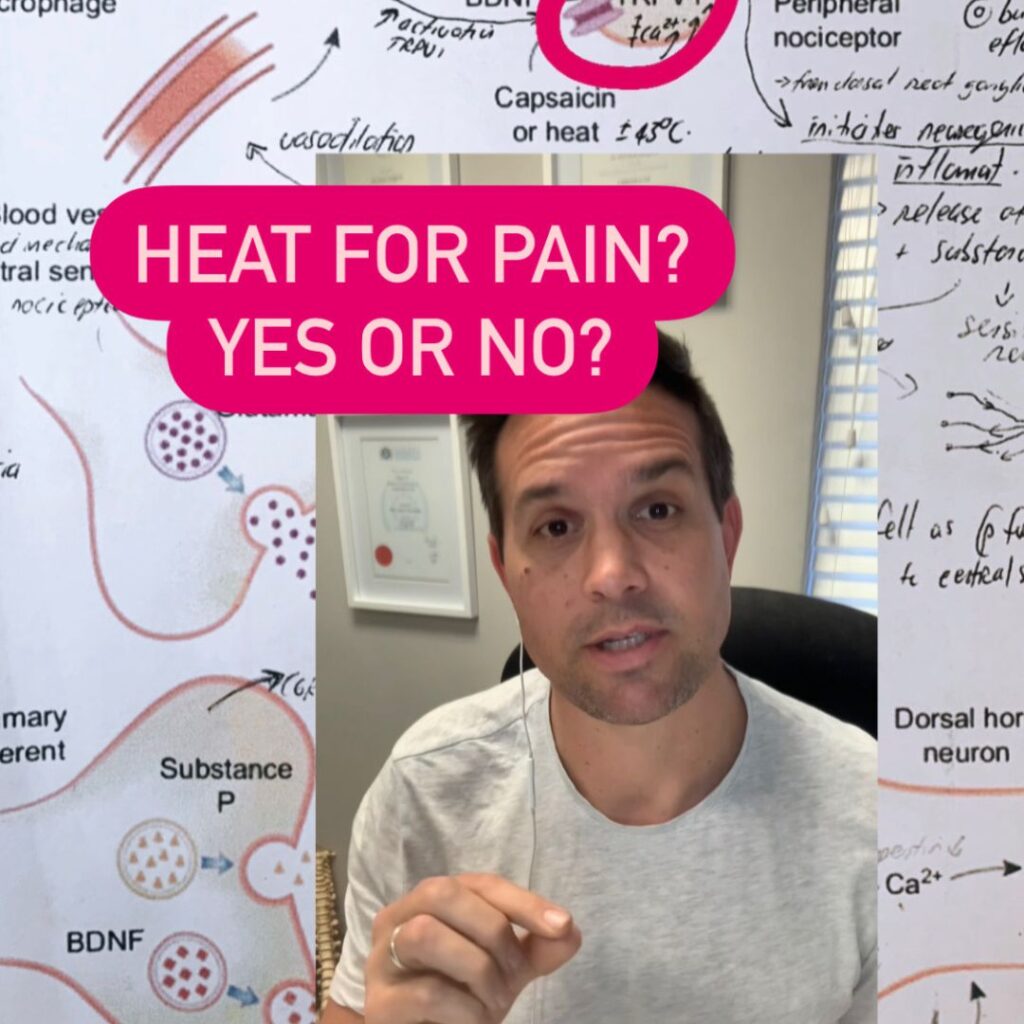
A fresh injury, a rolled ankle, a knock, a pulled muscle, brings a common question: should you reach for heat or for ice? Heat feels soothing, so it is often the first thing people reach for, but in the early stages of an acute injury it can work against you. Here is what happens in the body when tissue is injured, and why heat may not be the best choice in the first day or two.
What happens when you injure yourself
When tissue is injured, the body mounts an inflammatory response. This is normal and healthy, and it is the first stage of healing, not a sign that something has gone wrong. The injured tissue releases a mix of chemicals at the site, and these activate the nearby nerve endings. Those nerve endings send danger signals to the spinal cord and brain, where they can be translated into the experience of pain. Far from being a fault, this is a protective mechanism that prompts you to look after the area while it recovers.
A key player: the TRPV1 receptor
One receptor on the nerve endings, called TRPV1, matters a great deal here. After an injury it becomes sensitised, and once sensitised it responds to temperatures above about 43 degrees Celsius. Keep that receptor in mind, because it is the reason heat can backfire on a fresh injury.
Why heat can backfire on a fresh injury
With a sensitised TRPV1 receptor sitting at the injury site, adding heat sets off a chain of unhelpful events.
Heat switches on an already sensitised receptor
Applying heat to a fresh injury, where TRPV1 is already sensitised, triggers an amplified response from that receptor.
CGRP and Substance P are released
That response releases two compounds, CGRP and Substance P, which amplify the danger signals and further sensitise the nerve endings around the injury. The area can become more painful, even to something as gentle as light pressure.
More swelling and redness
CGRP and Substance P also widen the blood vessels, which adds to the redness and swelling at the site. The result is a feedback loop that keeps the pain and inflammation going, the opposite of what you want in the early stages.
So what should you do instead
Because of all this, heat is usually not the best choice in the first day or two after an acute injury, while the area is still inflamed. In that early window, ice is generally the more sensible option for settling things down. Heat has its place later, once the acute phase has passed and you are working on easing stiffness and restoring movement, but applying it too early can make a fresh injury more painful, not less.
If you have a fresh injury and are not sure how to manage it, or it is not settling the way you would expect, it is worth having it assessed. Book a visit and we will work out the best approach for your stage of healing.